Showing posts with label 1st Sikh Wars. Show all posts

Monday, 24 June 2019

Battle of Aliwal, 28th January 1846


Battlefield viewed from
British / EIC right flank
Friday 21st June, saw us start playing John and Dave's Sikh Wars game of the Battle of Aliwal, we used 15mm figures form Dave and John's collections and a localised version of Principles of War Rules specialising in the period.
Nigel, Rupert and Mike W, took the role of the British / East India Company forces whilst John, Mike N, Phil and Steve took on the role of commanding the Sikhs.
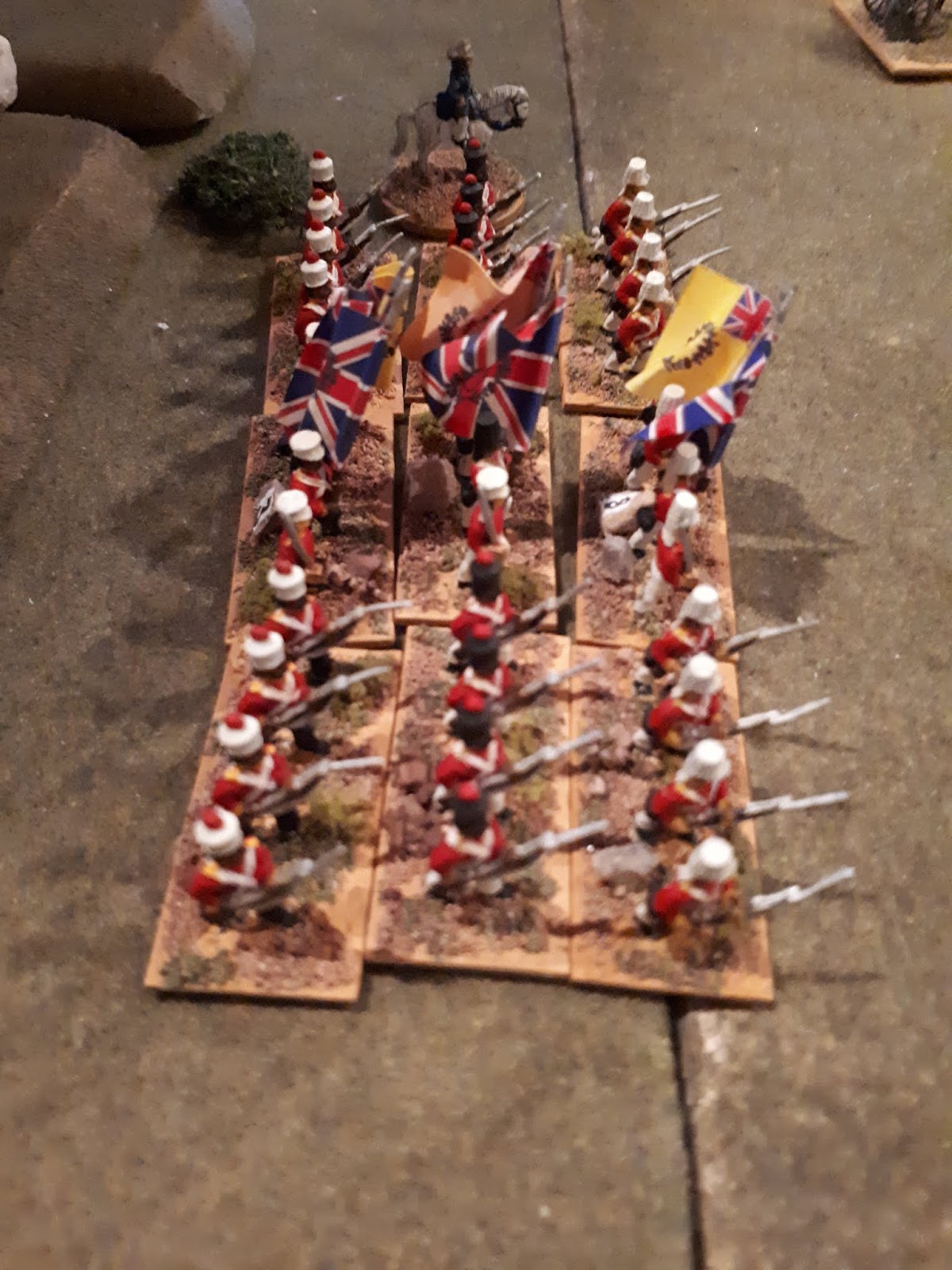
Rupert's advancing
British / EIC Regulars
The Sikhs deployed across the length of the table, with John commanding hordes of Sikh irregular foot on their right flank, Mike N, commanding similar on the central right and Steve same on central left of the line. On the extreme let flank of the Sikh line was their regular troops and hordes of their cavalry, commanded by Phil.

On the British side the decision was to focus their small number of units on their right flank.Mike W, commanding the two brigades of Cavalry - pitted against four brigades of Sikh cavalry. Rupert commanded two infantry brigades in eh center - facing-off Sikh regular foot regiments and then Nigel commanding a mixed infantry / cavalry brigade to protect the British left flank from the expected Sikh flanking attack,once they realise that they have no forces directly opposing them.

Sikh Cavalry on their left flank
British / EIC Cavalry Brigades
The game opened with the British cavalry and infantry forces advancing to meet and pin the Sikh regulars as they attempted to move out of the village on that flank.

Artillery was moved forward and on the second turn was able to start raking the Sikh troops with some effect.

Sikh cavalry charged and engaged with their British counterparts and y the end of the first evenings play honours were about even - with a couple British / EIC cavalry units being pushed back and one Sikh unit broken and two others seriously damaged. However weight of numbers looks like the Sikhs will likely overpower the British during week two.

Rupert advanced his British / EIC infantry and closed on the Sikh counterparts,however,there was no decisive outcome yet in that area.

Finally Nigel was able to turn his flanks to protect the rest of the British force against the hordes of
Sikh irregulars looming from that direction.

Week Two began pretty much where week one left off, except that the British / EIC leadership team lost the help of Nigel who was otherwise entertained!!

The Governor's Guard 
Notwithstanding that the British / EIC forces put up a sterling defensive withdrawal, on their right the highly trained Horse Artillery raked the opposing irregular cavalry mercilessly, inflicting high levels of casualties and breaking a number of units.

The Sikh flank attack developing
This artillery action, along with repeated cavalry interventions held back the massed Sikh cavalry units, by the end of week two about half of the 12+ Sikh  units were destroyed or very badly mauled. However, the same was true of the British / EIC units and their demise was near.

In the British / EIC center the foot units were able to withdraw in a managed manner, Phil's Sikh regular foot following up but hesitant in closing to try and destroy the British / EIC forces.

Close-up of the John's
Sikh Infantry
On the British left, now commanded by Rupert, John's horde of Sikh irregular foot swept round to hit the British / EIC makeshift line,the 4th Bombay Lancers made short shift or the irregular foot in front of them, breaking the unit and pursuing them from the field.

A neighboring regiment of British / EIC Gurkhas shot out a unit of Sikh fanatics and with heavy fire for other regiments in the line,John's flanking attack suddenly came to nought...

... however, behind John was Mike N's irregular Sikh brigade and the end was near for the British / EIC, by the end of the evening there was nowhere for the British / EIC forces to go, except off the table, the game was called and proclaimed a Sikh victory.

This scenario was taken from Wargames Illustrated, issue 271 <here>


For more information on the 1st Sikh Wars, see our other posts <here>

Saturday, 14 April 2018

Sikh Wars Battle - Photos

Tabletop Battlefield
Tabletop Detail
The Game

Staged on April 6th & 13th  by John & Dave, using their collection of 15mm Sikh Wars figures, fought over an 8' x 6' table.


Sikh Regular Cavalry

Sikh Irregular Cavalry

Sikh Irregular Infantry

Tuesday, 24 July 2012

The First Sikh War battles

by Dave Vallance

Here's a rough outline to the 4 battles of the first war..1845-1846

Mudki - 18th December 1845 
first battle, Sikhs under Lal Singh (remember him?)
bump into Sir Hugh Gough's advancing force (now known as the Army of the Sutlej) near the village of Mudki ..British win (huzzah!) and 3rd Light Dragoons win battle honour for charging down the Sikh gun lines


Ferozeshah - 21st - 22nd December 1845
  
Lal, having been given a bloody nose, retires to the village of Ferozeshah, where he digs in, throwing up earthworks around the village, in a horseshoe shape. He realises that his troops cannot manouevre in the open as at Mudki as well as the British, , so from now on the Sikhs develop the tactic of throwing up earthworks etc, with their heavy artillery well placed, and await the British attack..this tactic is now the norm for the remaining battles..a Sikh fortified defence attacked head on by the British and Sepoys.

Anyway, Sir Hugh Gough wants to attack straight away, but he is reined in by the Governor General, Sir, Henry Hardinge, who although acting as a subordinate. insists that Gough waits for another team to arrive, under Sir Charles Littler, who has been bottled up in the town of Ferozepore (not shah) which is on the River Sutlej, the border between us and the Sikhs, and to the north of Ferozeshah.

 Littler has been bottled up by another Sikh army, under their C in C, Tej Singh, but Littler manages to get out during the night and joins Gough.

Gough attacks on the 21st , wins with a Phyrric victory, drives the Sikhs out, but as the water in the village has been contaminated by the Sikhs, he is forced to retire to his start lines to get food, ammo, water etc.. during the night, the sneaky Sikhs retake Ferozeshah, and start bombarding the Brits again with their guns that the Brits hadnt spiked etc.

Gough, wants to attack during the night, but is again reined in by Hardinge (yes there is an 'e' at the end of his name, its not a typo)

The next morning, Gough attacks again and retakes Ferozeshah in a hard fought battle...we win again (another huzzah!!). however we are exhausted, thirsty, tired (having been shot at all night by the Sikh artillery) and down to our last rounds..when....Tej Singh's army turn up!! Oh crap, we are in deep shittings! 

Off we go again...the knackered Army of the Sutlej stand too, realising that they've got to fight again against a fresh Sikh army...however, Tej retreats when he sees British cavalry heading towards the flank....remember the plan to destroy the Khalsa from previous mails? Tej realised that he could beat the Army of the Sutlej, but the plan is to have the Khalsa beaten..."treachery, treachery", is the cry from the Sikh soldiery..The Brits and Sepoys breath a big sigh of relief.....now there comes a 'what if?' What would happen if Tej attacked?

Could this have led to a general Indian uprising?

Aliwal - 28th January 1846 - 'the battle without a mistake'
well we won't be doing this game!

Another Sikh force under a Ranjoor Singh was trying to cut off our supply lines and Gough sent Sir Harry Smith to stop him, which he did (shall we have another huzzah?) at the village of Aliwal.

16th Lancers charge and break a Sikh regular infantry square, another battle honour

 Sobraon - 10th February 1846

By now the Sikhs had retreated back to the River Sutlej, this was
their last stand..again earthworks on a semi circle, their rear on the river itself with a bridge of boats going across, artillery on far bank proving support..another frontal assault, Gough by now had some heavy seige guns which he used effectively, but when told they were running low on ammo, his famous quote of "thank god, at last I can get at them with the bayonet" came about here. Once the lines were breached, by cavalry no less, and help arrived, the Sikhs headed for the river , some swimming, some trying to cram across the bridge which collapsed...now it became a turkey shoot for the Brits..the Khalsa was effectively destoyed and the remainder surrendered..the First Sikh war was over...

All of these battles were hard fought affairs, the British being surprised and impressed by the unanticipated courage and determination of the Sikhs. Many British officers thought that Ferozeshah was ' a very desperate affair'.. the Sikhs actually claimed it as a victory. If it was a British victory, then it certainly wasnt a decisive one. General Gough also admired the martial qualities of the Sikhs . He one said "Never did a native army having so relatively slight an advantage in numbers fight a battle with the British in which the issue was so doubtful as at Ferozeshah"

Check out Dave's excellent Sikh Wars Introductory article <here>