Showing posts with label Austrians. Show all posts

Sunday, 23 November 2025

Friday Night Games: 15mm Medieval

Friday 14th & 212t at saw us playing a 15mm Medieval game which saw a force of German Nurembugers trying fighting off a force of Austrians

The figures were from John's collection and he umpired the game using his version of Rupert's rules.


Austrians we're commanded by Dave, Rupert and Mike N. whilst the Bavaruan side were commanded by Mat, Steve & Phil.

Sunday, 25 May 2025

Friday Night Games: Annual Napoleonic Big Game - The Battle of Apsern-Essling (Week Two)

    Week two same the same commanders resume their positions as the Austrian attacks drew ever closer to the French lines. Tis represented Day Two of the battle, with some redressing of lines having been allowed 'overnight'. 

French occupying the urban area on their left flank

An early Austrian attack on the church and graveyard are soundly repelled by the defending French. THe Austrians loos three battalions destroyed in the attack and they then circumnavigate the area. Mike W's 1st Corps head left of the church whilst Warrens's Corps head right and push a flank march through marshy ground attempting to reach the French rear.

French defenders in their centre left, commanded by Dave

Austrians advancing on their left flank

French emplaced batteries on their right

French units under Nigel occupying urban area on the French right flank

French centre right

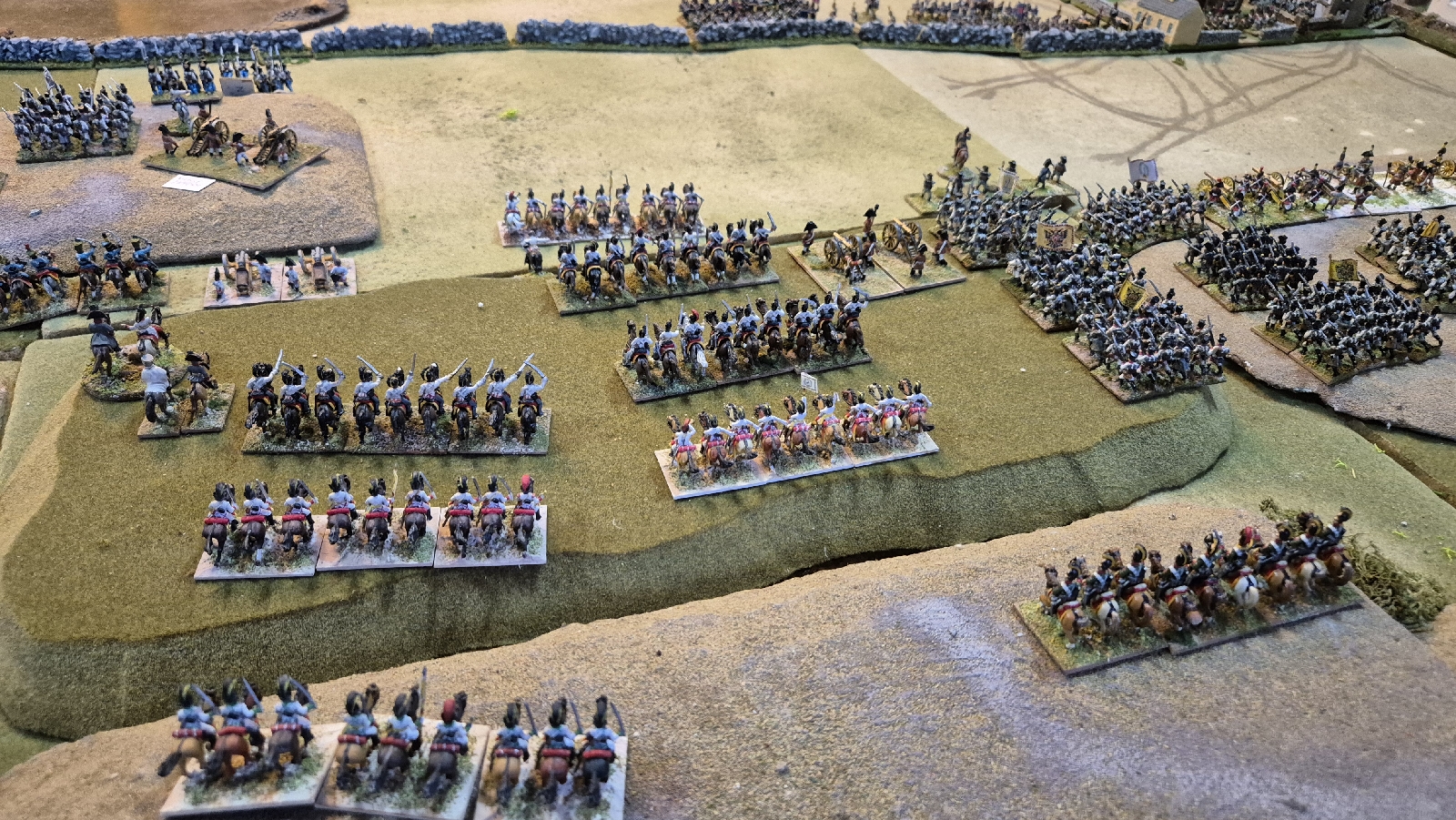
Austrian cavalry arrive on their centre left

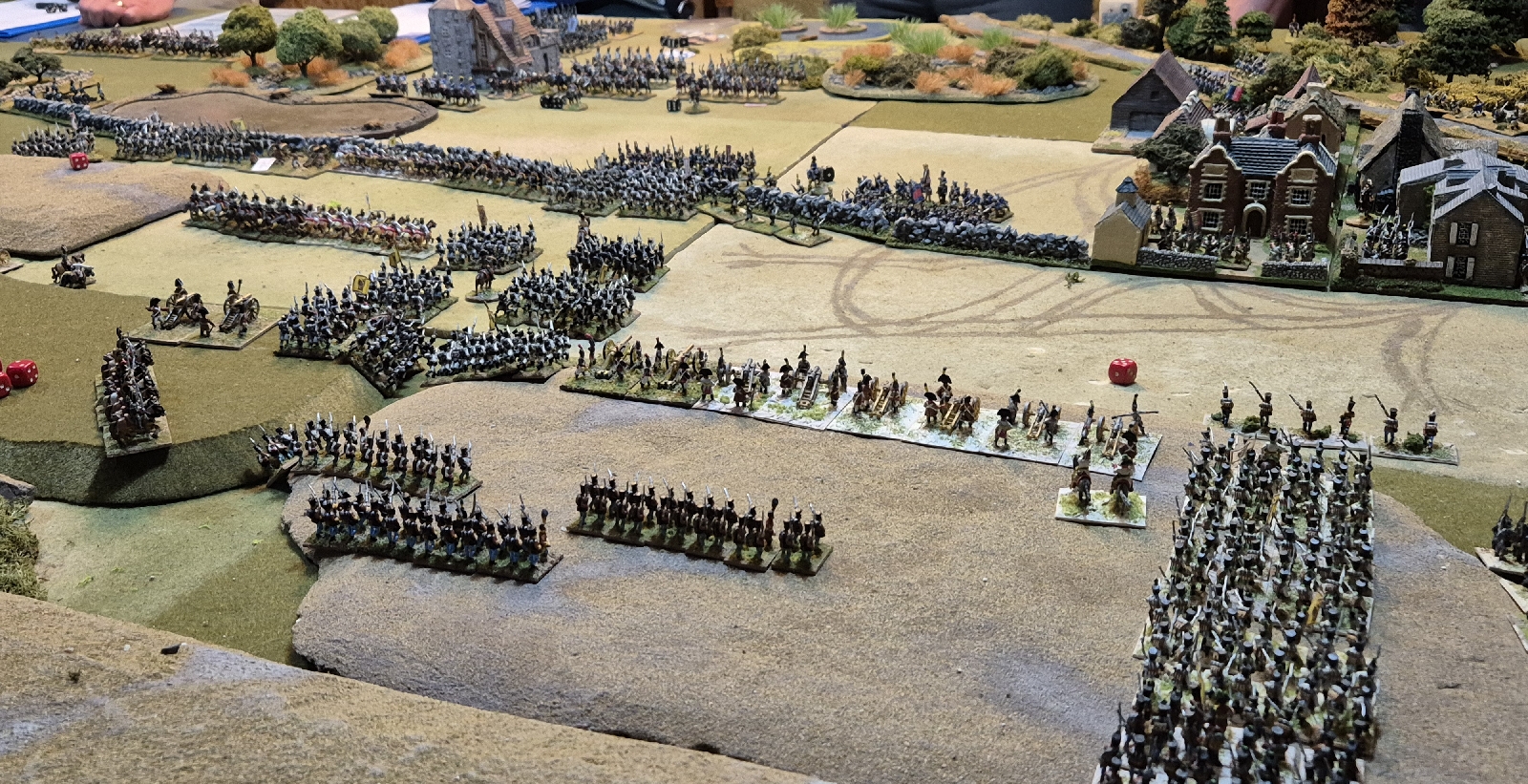
Wider view of the Austrian attcking positions on Day Two

Austrian attacks in the centre have more success with the line of the dyke breached by a number of Austrian units - both Infantry and Cavalry, several French battalions are lost. However, the French Guards Divisions are coming onto the tabletop in their rear.

Austrian attacks in the centre start to put French under pressure

Austrian left of centre

Massed Austrian batteries, to the right of the line, pound the French lines.

The French try to hold the line in the centre but are hampered by the need to defend against the Austrian flank march, only the French Guards seem to have the ability to puch back at the Austrians.

Another wider view of the attacks, in the right background can be seen a sweeping Austrian flank move, through marshy ground.

To compound the French problems in the centre Mark is able to deploy his Austrian Corps to deliver a massed attack on the French right wing. As WQeek Two closes, the game lies in the balnce.

End of Week Two and Austrian attacks go in on the French right flank.

Saturday, 17 May 2025

Friday Night Games: Annual Napoleonic Big Game - The Battle of Apsern-Essling (Week One)

Friday 8th May saw us meet at Rupert's gaff to play John's 15mm recreation of the Battle of Apsern-Essling, where Napoleon was caught by the Austrians as he crossed the Danube.

The figures were supplied from the colections of John, Rupert & Dave - possible plus others!

The Austrian forces were commanded by Rupert and he was aided by Steve, Mark, Mike W & Warren whilst the French were commanded by Mike N and his sub-commanders - Mat, Davel & Nigel.

The French right flank at the start of the game, commanded by Nigel

French positions on their left flank, commanded by Dave

And the sparcely defended French centre, commanded by Mat and Mike N when his troops arrived

Most of the Austrian forces had to march on  to the table, with Mike W & Warren's Corps on the Autrian extreme right, Steve's Corp on the centre right and Rupert taking the centre and Mark's Corps takling the Austrian left.

Austrian 1st Corp arriving on the tabletop on Turn One.

A wider view of the Austrian extreme right, with Mike W & Warren's Corps at the edge of the world

Austrian trioops advancing

Steve's Austrians advancing 

More advancing Austrians!

Austrian centre an left

End of play on Week One, a massive Austrian attack, involving 3 Corps, is developing on their centre right and right wing. 

Sunday, 3 July 2022

Friday Night Games - The Siege of Vienna, 1683

Friday, 1st July saw the much overdue playing of Mike W's 28mm Siege of Vienna game. It was staged at Mike N's venue and used Warlord Games Pike & Shotte rules, with some variants to keep the mechanisms simple and flowing.

On the allied Austrian / German/ Polish side (Hereafter referred to as the Western Allies), we had Mark, playing the Austrians and thus assuming that he had overall command and taking up a position on the right of the line.

This notion was not fully endorsed by Mat, who commanded the Polish Divisions in the centre. Ably assisting Mat was Phil, commander of the Polish 2nd Division.

On the left of the line was Dave  playing a polyglot of German allies  loosely known as the German (or Imperial) division.

Massed Austrian, Polish & German Cavalry Divsions

Phil threw he cat amongst the pigeons by playing his black mark ⚫ on turn one against Mat's division. The resulting blunder sees Mat' two units of Cossacks leaving the field, they did not return for several turns much to everyone's amusement.


Mark's Austrian Cuirassiers & Mat's Polish Panceri race ahead on the right

On the Ottoman side, we had Steve playing ad the Grand Vizier  commanding the Janissaries & Sipahis of the Porte as well as the artillery.

He was backed up by Mike N, who as First Vizier had command of the Heavy & Feudal Sipahis.

Turkish and vassal light cavalry was under the command of Nigel  whilst Infantry units were split between them in the absence of John  who will be re-joining his command in week two.

Ottoman Tufecki Infantry supported by Ottoman Deli Light Cavalry & Hungarian Hussars

The Western Allies plan was straight forward, a rapid advance straight forward! This was enacted as rapidly as possible but somewhat held-up as commanders struggled to get there orders out to their units in a timely manner. 

Orders being subject to a Command test based on their commander's capability ratings.

Over a course of a few turns, Mat's Poles and Mark's Austrians were behind the pace. On the left Dave's Germans  led by he Bavarian Cuirassiers  made much better progress.

Towards the rear of eth Ottoman lines there is much activity,
Janissaries in the background and Sipahi Cavalry manoeuvring to their front 

On the Ottoman side, commanders scurried from their tents to join their units to put together a defensive plan.

Nigel's Light Cavalry were soon in the thick of it  managing to give a good account of themselves alongside various Azab and Tufecku Infantry units.

Polish Panceri Heavy Cavalry with a unit of staggered Cossacks behind.

End of week one and there's all to play for, Ottoman units are holding g up well but two Infantry and two cavalry units have been sent back to the box.

The Western Allies have four of five units with casualties and their opponents have two or three on the same situation.

As ever I'll leave much of rest of the report to the pictures, week #2 is due to be played July 8th.

Polish Winged Hussars make contact with Ottoman Mamelukes,
the Mamelukes held out for one turn but were destroyed in the following melee round!


General view of eth table from the Western Allies right flank,
looking down the table to eth Ottoman Right 


The game in full play, Week #1

Week Two saw a slight change in the Ottoman line-up, Nigel was unable to attend but his place was ably taken by John, who took command or the Ottoman Light Cavalry.

The Western Alliance continued to roll forwards, eliminating Ottoman units and pushing them quite quickly into their own half of the board. On the left flank the Bavarians continued to do well, but at the loss of one unit of Cuirassiers. Luckily within the German Division the Saxon Cuirassiers stepped up to replace them.

On the right flank of eth Western Allies, Austrian Horse advance behind their Cuirassier comrades

Austrian Cuirassiers wheel to engage Hungarian Hussars to their left

Ottoman Guns finally come into play and start to bombard advancing Western forces

The grand sweep of the Western forces as they close with the Ottoman infantry's defensive lines in the centre of the board.
The Polish Winged Hussar unit at the bottom of the picture has just been staggered by artillery fire

The rest of the line from above!

Ottoman Sipahi of the Porte advance out of their camp to engage
with the approaching Austrian Juggernaut

Not so good photo of eth Ottoman Infantry's positions


Time was called at the end of week two, The Western assault on the Ottoman lines was just starting, albeit that the infantry positions were being avoided as much as possible. On the Western left it was deemed that he German division would likely break through the Ottoman cavalry and levy lines, enabling them to flank the Janissary positions in the centre, on the right the Austrians had a much harder fight to overcome the four units of the Sipahi of eth Porte and a Janissary of eth Porte unit.

In the centre the Poles would have had to crash into eth Janissary lined up behind Chevaux de Fris, another tough ask but with cunning and bravery it would have been possible! But we'll never know for sure.

Thanks to all that played.

Thursday, 14 April 2022

Siege of Vienna - Part Two: The Imperial Cavalry

The forthcoming Siege of Vienna Scenario will pit the combined Cavalry resources of the Holy Roman Empire and the Polish - Lithuanian Commonwealth against the Ottomans, in a do or die battle...

The Imperial Cavalry Divisions at Vienna, the Austrian Division
is on the right and the Imperial client State Division to the left

By way of background the Siege of Vienna was entering its final stages when John III Sobieski, allied with Holy Roman Emperor Leopold I to deal crushing defeats to the Ottoman Empire. The 1683 battle marked the final turning point in the 250-year struggle between the forces of Christian Europe and the Islamic Ottomans. 

For its centuries-long opposition to Muslim advances, the Commonwealth would gain the name of Antemurale Christianitatis (bulwark of Christianity). Final victory for the allies was to take a further 16 years, a period known as the Great Turkish War, which would see the Turks permanently driven south of the Danube River, never again to threaten central Europe.

In Part One of these posts, I reviewed the Polish Divisions available to the players, here I will look at the Imperial Forces - again two divisions - one solely consisting of Austrians and the other made-up of a number of units from German client nations.

The Austrians

The Austrian Division consists of three Regiments of Cuirassiers and a Regiment of unarmoured Horse. The unarmoured Horse regiment consists of two squadrons which may act individually or in unison with each other.

Austrian Horse, with the Austrian Commander of Horse

Similarly there are two Austrian Cuirassiers units both with two squadrons, which may act as per the Horse squadrons above. There is also a Third Austrian Cuirassier unit of just one squadron that may be used independently or may be added to one of the two Cuirassier units noted above and allow that unit to operate in unison as a three squadron regiment if so desired.

First Austrian Cuirassier unit with the Austrian Cuirassier Leader attached.

Second Austrian Cuirassier unit, all depicted as carrying Pistols.

Austrian Cuirassiers count as Armoured Heavy Cavalry and are thus not so quick on the table-top, they are armed with Swords and Pistols. When deployed in multi Squadron regiments they may use their weight on numbers to ad to their impact when making contact with the enemy.

Unarmoured Austrian Horse move somewhat quicker than their armoured brethren and they may also make use of Impact bonuses when making contact with the enemy if they are deployed with their squadrons acting in unison

Third Austrian Cuirassier unit, this unit may be deployed independently or it may be attached permanently to one of the other Cuirassier units to make that unit a three Squadron Regiment

So the Austrians have a total of seven Squadrons of 6 figures each - giving a total of 42 figures, plus a Commander of Horse and a Commander of Cuirassiers.

The Germans

This German Cavalry division represents all the units supplied to fight as part of the Imperial Army, alongside the Austrians and as such it is made up of a number of different nationalities. Again these are all Cuirassiers, with one unit of regular Horse.

All the above notes about squadrons acting in unison apply here as well.

Saxon Cuirassiers, with their Leader, a two squadron Regiment

Bavarian Cuirassiers and their National Leader

Brandenburg Horse, two squadrons strong. 

Wuttenburg Cuirassiers, a single squadron regiment,
they cannot combine with any other regiment

Numbers wise, this division has another seven Squadrons of 6 figures each - giving 42 figures, plus four National Leaders.

With the Imperial Commander that gives a total of 91 figures.

More about their Organisation

Oh where to begin about explaining the organisation of the Imperial Army! 

Lets just be kind and say it was hugely bureaucratic and inefficient! The Holy Roman Empire was dominated by the Austrians, other states were not bound to the decisions of the Emperor but generally went along with his desires but there were always exceptions and caveats to the rule. 

To represent this commands to the Imperial Commander of Horse must send orders to the National Leaders, before passing these on to the units themselves. Austrian Leaders command multiple units, the Imperial Client State leaders just one

Commander of the Imperial Horse

Coming Soon... 

Part Three: The Ottoman Cavalry